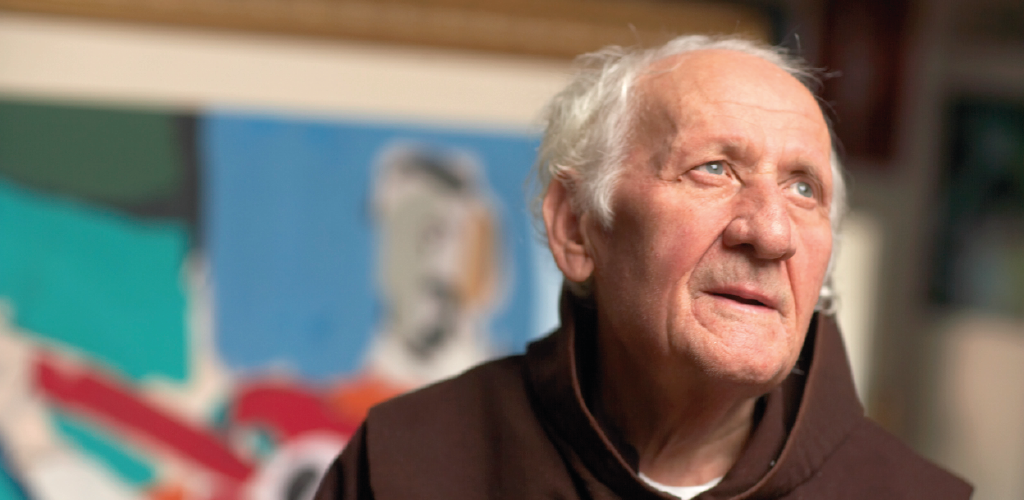


Painter, sculptor, stained glass artist, 'batisseur d'églises' and finally - or first and foremost - Franciscan friar and priest, Father Costantino was, as Mario Sironi described him, a soldier of two militias: that of faith and that of art.
From his childhood in the countryside of Franciacorta to his youth in the convents of Busto Arsizio and Trento, to his ordination as a priest in Milan, from his pictorial trials to the great masterpieces that made him the main architect of the renewal of sacred art in Italy, the story of Costantino Ruggeri, a man of faith and religion, is inextricably intertwined with that of the artist.
never betray, at any cost, beauty'.
And, quoting Dostoyevsky: 'Only beauty will save the world'.
A friend of the greatest representatives of Italian art of our century - from Fontana to Sironi, from Morandi to De Pisis, from Manzù to Carrà - Costantino Ruggeri, worker of dreams, had in 1960 the perhaps decisive encounter of his itinerary, that with Le Corbusier. Since then, "the architecture of mystical space" has been his main occupation: "to build a church that would not separate, but unite with its structures all of creation, light, trees, living images, the natural sounds of nature". And it is no coincidence that, in his attic suspended between the roofs of Pavia and the sky, in silence and prayer he created the new Sanctuary of Divine Love in Rome "the living harmony of a blue grotto" and was the creator of the Frate Sole Foundation to capture in the world the splendour of the sublime and the passion of the divine.
To those who asked him the reason for these initiatives, he replied with the candour of a young boy from Franciacorta, referring to Matisse: